The only reason I was looking for alternative investments when I started blogging is that I couldn't find any good investments with decent yield.
The environment has changed quite a bit in just a few months. For one thing, I found a 7-month CD yielding 6.45% at a local credit union, so I put 100K into it. I would have put a lot more into it, but didn't because of the 100K FDIC limitation.
I put 50K into a currency trade product offered by Morgan Stanley. It's a capital-protected hedge against a falling dollar vs a basket of emerging market currencies. I don't have the prospectus readily available, but essentially if the dollar falls against a basket of Brazilian, Russian, Indian, and Chinese currencies by 2008, I make ~7.5% APR. The more it falls, the higher my return. Should the dollar rise vs those currencies, I get my original investment back. I had to really think about this vs buying more CDs at 6.45%, but thought it was a decent bet.
The decline in energy and precious metals over the last few months finally enticed me enough to put a little cash to work in stocks a couple of days ago. I targetted yield (REITs and energy trusts), energy stocks, and gold stocks. I am underinvested in these areas but didn't want to put money in when they were at such lofty levels. I expect oil and energy to decline further, so I'm just starting to scale in. One oil stock I picked up is DVN, this company made a recent discovery in the Gulf of Mexico that potentially doubles their reserves, but the stock didn't move. I'm surprised by the lack of interest, since I see lots of media coverage. This is what happens during distribution, and signals to me that energy has further to fall. Energy is still at very high valuations, and could fall for a long time.
I considered housing (KBH, TOL, PHM), because of the extreme pessimism in that sector over the past year. I regret not making some small purchases there (look how it's done over the past week). But time will tell whether this is just a temporary rebound. Meanwhile, I wait patiently to see what happens.
I am also waiting to pull the trigger on buying healthcare funds. I think this is a good sector to be in for the next couple of decades. A lot of stocks in this sector have been moving sideways for years, and action has started to look interesting the last few weeks.
I am still holding a lot of cash, but now that money market yields are all close to 5%, I'm not in any hurry to deploy. I think my cash position is even higher than a month ago despite putting another 250K to work, as I've vested more company options which I subsequently sold, made some huge gains on ESPP, and have been selling off long-term company stock holdings too (it's near an all time high).
Thursday, September 14, 2006

Diversification, again
I came across a blog I found interesting:
http://uhnwi.livejournal.com
He discusses some topics I wish I had exposure to several years ago.
But I'm practically screaming, "Are you crazy?!! Sell, sell, sell!!!!!!"
I guess the author probably has ~$30 million or more concentrated in company options, and doesn't want to sell because of capital gains taxes. For some reason, he seems to think his company is invincible (must be a Google employee :P ). I have seen enough over the years (especially during the dotcom crash) that I wouldn't be comfortable to be 100% invested in company options. It's true that to achieve extreme wealth financially, you have to be focussed rather than diversified. But to not diversify once you hit $30M, or even $10M, is just plain folly. What do you think?
Enron and WorldCom both seemed invincible at one time.
http://uhnwi.livejournal.com
He discusses some topics I wish I had exposure to several years ago.
But I'm practically screaming, "Are you crazy?!! Sell, sell, sell!!!!!!"
I guess the author probably has ~$30 million or more concentrated in company options, and doesn't want to sell because of capital gains taxes. For some reason, he seems to think his company is invincible (must be a Google employee :P ). I have seen enough over the years (especially during the dotcom crash) that I wouldn't be comfortable to be 100% invested in company options. It's true that to achieve extreme wealth financially, you have to be focussed rather than diversified. But to not diversify once you hit $30M, or even $10M, is just plain folly. What do you think?
Enron and WorldCom both seemed invincible at one time.
Saturday, September 02, 2006
My date with Merrill (Lynch)
Has anyone seen "My Date with Drew"? I thought it was a cool movie, shows how someone can achieve what seems to be impossible on nothing but desire and tenacity.
I spent over an hour interviewing a financial advisor from Merrill Lynch's private client group. The goal of the meeting was to find out what Merrill could do for me, and his proposal for financial strategy.
I had given him a list of some of my mutual fund holdings, and he went through some analysis for me. His goal was to convert me from mutual funds to managed funds and hedge funds. Here are some key points that I've gleaned from the meeting, my own past experience with managed funds, and some discussion with an ex-Merrill Lynch client:
1. Minimum account they're willing to work with is ~600K. Typical managed fund and hedge fund minimums are 100K, so 600K would be enough to start 3 managed funds and 3 hedge funds, all with different management styles.
2. Average account size in this private client group is $2M.
3. Managed accounts allow you to tax loss harvest at the end of the year. You can advise the manager of your tax situation (i.e. that you have capital gains you want to offset), and instruct them to take individual stock losses against your gains. This is something you wouldn't be able to do with a mutual fund, since you have no control over the underlying fund assets.
4. You purchase the underlying shares in the managed account, so your cost basis is the actual share price on the date of purchase. When those shares are sold, you are taxed on actual gains (or losses). For mutual funds, when you purchase the mutual fund, the fund already holds those underlying shares, likely with a cost basis lower than the market price at the time you made the purchase. When the mutual fund makes a distribution, you are taxed on the gains the fund made from its original purchase price, not at the price you paid. Your fund could have lost value, but you'd still have to pay capital tax on the distribution. This is awful, and so is another big benefit of managed funds.
5. Management fees. Merrill charges its own 1+% fee, and the managers charge another 1-2%, so the fees add up. However, mutual funds have hidden fees besides the management fees shown on Yahoo finance, including transaction costs and taxes. www.personalfund.com has more details of all the costs associated with a particular fund. Depending on the fund, Merrill's fees may actually work out to be lower. But if you're going for lowest costs, ETFs or Vanguard funds would be good bets.
6. Tax complications. If you own hedge funds, you will probably have to file for tax return extensions every year, because you don't receive final tax documents (K-1s) until after April 15.
7. Hedge funds did well in 2000-2002, but many of them seem to be lagging the market from 2003-present. This is probably related to the huge amount of money being poured into hedge funds the last several years. One thing I like about hedge funds is that their volatility seems to be generally lower than the overall market.
8. They don't offer tax liens or real estate deals. Need to go with Citibank for those.
My conclusion? If you've got all the time in the world, it's better for you to do your own research and manage individual stocks. For those with net worth less than a few hundred K and no time, stick with ETFs, mutual funds, and some individual stocks. For those with net worth > $1M and no time, it's still kind of a toss-up, fund selection is key whether you go with mutual or managed funds. For those with net worth > $5M, you pretty much need someone to help you diversify.
I'm going to stay the course and not go with Merrill yet. Will interview more financial advisors. It's a time-consuming task.
I spent over an hour interviewing a financial advisor from Merrill Lynch's private client group. The goal of the meeting was to find out what Merrill could do for me, and his proposal for financial strategy.
I had given him a list of some of my mutual fund holdings, and he went through some analysis for me. His goal was to convert me from mutual funds to managed funds and hedge funds. Here are some key points that I've gleaned from the meeting, my own past experience with managed funds, and some discussion with an ex-Merrill Lynch client:
1. Minimum account they're willing to work with is ~600K. Typical managed fund and hedge fund minimums are 100K, so 600K would be enough to start 3 managed funds and 3 hedge funds, all with different management styles.
2. Average account size in this private client group is $2M.
3. Managed accounts allow you to tax loss harvest at the end of the year. You can advise the manager of your tax situation (i.e. that you have capital gains you want to offset), and instruct them to take individual stock losses against your gains. This is something you wouldn't be able to do with a mutual fund, since you have no control over the underlying fund assets.
4. You purchase the underlying shares in the managed account, so your cost basis is the actual share price on the date of purchase. When those shares are sold, you are taxed on actual gains (or losses). For mutual funds, when you purchase the mutual fund, the fund already holds those underlying shares, likely with a cost basis lower than the market price at the time you made the purchase. When the mutual fund makes a distribution, you are taxed on the gains the fund made from its original purchase price, not at the price you paid. Your fund could have lost value, but you'd still have to pay capital tax on the distribution. This is awful, and so is another big benefit of managed funds.
5. Management fees. Merrill charges its own 1+% fee, and the managers charge another 1-2%, so the fees add up. However, mutual funds have hidden fees besides the management fees shown on Yahoo finance, including transaction costs and taxes. www.personalfund.com has more details of all the costs associated with a particular fund. Depending on the fund, Merrill's fees may actually work out to be lower. But if you're going for lowest costs, ETFs or Vanguard funds would be good bets.
6. Tax complications. If you own hedge funds, you will probably have to file for tax return extensions every year, because you don't receive final tax documents (K-1s) until after April 15.
7. Hedge funds did well in 2000-2002, but many of them seem to be lagging the market from 2003-present. This is probably related to the huge amount of money being poured into hedge funds the last several years. One thing I like about hedge funds is that their volatility seems to be generally lower than the overall market.
8. They don't offer tax liens or real estate deals. Need to go with Citibank for those.
My conclusion? If you've got all the time in the world, it's better for you to do your own research and manage individual stocks. For those with net worth less than a few hundred K and no time, stick with ETFs, mutual funds, and some individual stocks. For those with net worth > $1M and no time, it's still kind of a toss-up, fund selection is key whether you go with mutual or managed funds. For those with net worth > $5M, you pretty much need someone to help you diversify.
I'm going to stay the course and not go with Merrill yet. Will interview more financial advisors. It's a time-consuming task.
Saturday, July 22, 2006
Cash flow update
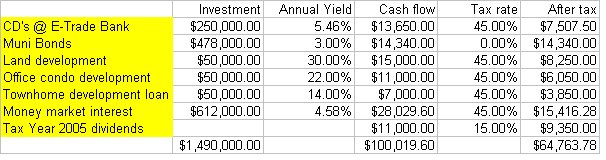
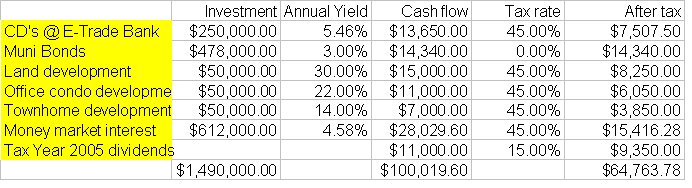
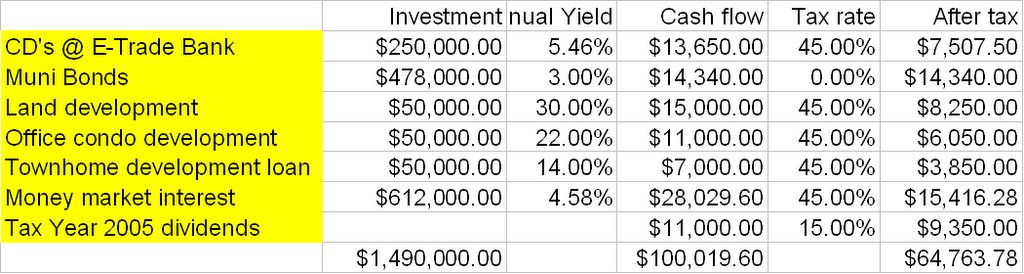
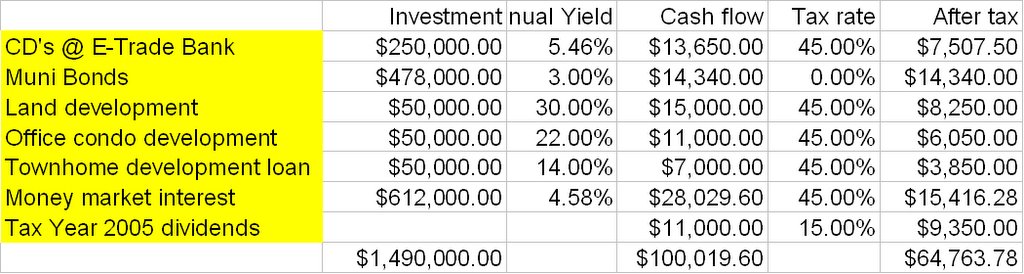
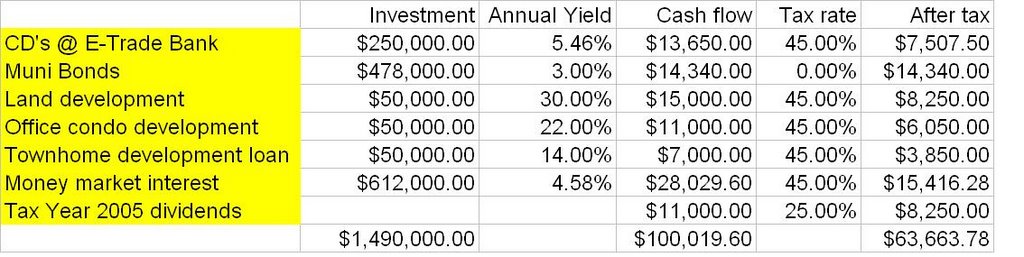
Most blogs I've seen publish a monthly balance sheet with assets and liabilities. I think a more useful financial statement for me is the cash flow statement. This statement is what I've been working on improving the past month or so. Here is an estimate of where it currently stands:
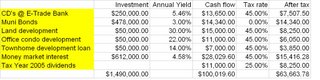
Without a lot of work, I've gotten my estimated annual cash flow up to a decent amount already. I am using the conservative numbers from the pro forma statements generated for my investments. Also, when doing my 2005 taxes, I found out that my dividends were still surprisingly low, so I was working on improving that over this past year also. It's hard to tell how much the dividends have improved without spending a lot of time on it, since each stock holding varies and dividends can change from quarter to quarter.
I am slowly moving the money market funds over into other investments. I think frugal has some great ideas at http://www.1stmillionat33.com/2006/06/list-of-high-yield-dividend-stocks/. In fact, I think that blog entry and his blog entry about MLPs were the most useful nuggets I've found in all of the blogosphere (As an aside, most other blogs I've glanced through write about saving or making a few dollars here or there - for example on no-interest credit card offers, or trying to squeeze an extra 0.1% out of some online banks. Nothing wrong with that, unless you can find other ways to make bigger money with your time.)
I still have not found the time to call up some private client groups to find out if they offer tax lien certificates, or real estate deals. I met a lady from Citibank's private client group several years back who said her group doled out vetted real estate deals to their clients.
Without a lot of work, I've gotten my estimated annual cash flow up to a decent amount already. I am using the conservative numbers from the pro forma statements generated for my investments. Also, when doing my 2005 taxes, I found out that my dividends were still surprisingly low, so I was working on improving that over this past year also. It's hard to tell how much the dividends have improved without spending a lot of time on it, since each stock holding varies and dividends can change from quarter to quarter.
I am slowly moving the money market funds over into other investments. I think frugal has some great ideas at http://www.1stmillionat33.com/2006/06/list-of-high-yield-dividend-stocks/. In fact, I think that blog entry and his blog entry about MLPs were the most useful nuggets I've found in all of the blogosphere (As an aside, most other blogs I've glanced through write about saving or making a few dollars here or there - for example on no-interest credit card offers, or trying to squeeze an extra 0.1% out of some online banks. Nothing wrong with that, unless you can find other ways to make bigger money with your time.)
I still have not found the time to call up some private client groups to find out if they offer tax lien certificates, or real estate deals. I met a lady from Citibank's private client group several years back who said her group doled out vetted real estate deals to their clients.
The biggest roadblock to wealth
I think the biggest roadblock to wealth is a person's own mind, and way of thinking. The most common emotions that get in the way are fear and apathy. Here are some common reasons that prevent people from investing or making more money:
some examples of fear:
1. I don't have much. I don't want to lose it.
2. That's too risky.
3. I'll invest once I make more money.
4. I remember the last time I took a chance.
5. I have a wife and kids, I can't afford to be wrong.
some examples of apathy:
1. I make enough and I can live well with what I make, I don't need to make more.
2. I'm too busy with my job, I don't have time for investing outside of work.
3. I'll never figure out this investment stuff, it's too complicated.
4. I'll invest when I see a good opportunity that comes along.
5. Oh, I never even thought about investing or ways to make more money.
6. The game is rigged. Nobody can make money unless you're on the inside.
I purposefully picked some examples that totally make sense to me. I definitely fall into the fear camp, but I can totally understand the apathy camp too.
Now that I'm making active investments outside of work (other than stocks + mutual funds), I've reflected on why I didn't do it earlier. I think it's because my frame of mind has changed.
From reflection, I can remember a lot of opportunities that I passed up in the past, because of fear or apathy:
1. In '99 I was given a pre-IPO offer with a big options package by the founder of what is one of the largest communications semiconductor companies now (worth over $20B before this recent market collapse). I had just been through a start-up experience, so turned down the offer because I thought I was too burned out to do another one even though I was 100% sure they would hit it big (I ended up working just as hard at the job I didn't leave). Can you imagine winning the lottery twice in your life?
2. I did a major remodel of my house several years ago. Contractors were getting rich by buying run-down old houses in nice neighborhoods for $600K, tearing them down, rebuilding them with $400-500K investment, and then reselling for $1.2M - $1.5M. I used a decent, honest builder for my remodelling job, and we discussed doing such a project, but from pure laziness I never followed up on it. All he needed was more capital.
3. In my past dating experiences, I met a lady in 2003 who had been working for 5 yrs at the city planning commission or city building dept (can't remember which), who was responsible for managing construction projects all over the Bay Area. She was well connected with many contractors, and was intimately familiar with Bay Area neighborhoods. We did joke that we'd make good business partners, she knew exactly what needed to be done for a successful condo conversion and the best locations for doing such a conversion, but was too young to have built up the working capital yet (I think owning a new Mercedes AMG didn't help). I passed on a 3rd date, and passed on the project when she got engaged 2 months later.
4. My co-workers and I made fun of another co-worker who flipped a million dollar mansion in less than 2 mos last year. In the Bay Area, you have to enter a lottery system to gain the right to buy a new house, and it's been this way for desirable properties since 1991. Well, this guy won the lottery, bought a house for $1.2M, then re-entered the lottery again and won again a month later, bought the second house for $1.2M, and then sold the first house 2 months later for $1.5M. All in the space of 3 months. We laughed at him, but who can't use an extra $300K in 3 months for doing no work? Winning the housing lottery was just like winning a real lottery, except the odds are more like 2:1 or 3:1 rather than 18,000,000:1.
5. I have a childhood friend whom I've known for over 30 years. We went to the same grade school, high school, and university. He built his company into one of the largest architectural firms in Silicon Valley. Definitely a guy I could have invested with on real estate projects, but in our 30+ yr friendship, we've never discussed money.
6. In 2000, my girlfriend at the time and I went to visit her La Jolla condo where she used to live. She had forgotten to bring her key so we had to call a locksmith. During the 30 mins we spent with him, he described how he had been buying up condos and renting them out, and was up to 6 properties already (highly leveraged). After he left, I remember that we were shocked by the risk he was taking, the time period was post stock market crash when everyone was expecting overinflated real estate to go down with the stock market. Well, I can imagine where that locksmith is sitting now. Those condos went from $150K to over $400-500K in 6 short years. Looking back now, I don't think there was much risk involved as long as he had a fixed mortgage and was cash flow positive on the rentals (good luck finding a cash flow positive rental property in CA now). We looked around at new housing developments, but never got serious about buying one.
7. I've come across lots of business opportunities to do some kind of trade in China. The latest I heard was from a friend in China who has a Saudi ex-classmate. This ex-classmate is looking to import air conditioners into Saudi Arabia from China that pass Saudi certification standards. Again, they just need a little research and a little capital to get going. In the past, I could have been part of deals on recycling used car tires, high fidelity speaker components, etc. But always too lazy or busy to look into it further.
8. Just last month I saw an ad for buying a hotel room/condo at the W-hotel in Las Vegas. Out of curiosity, I called to ask pricing and their plans for renting out the room when you're not using it. They gave me their sales pitch, pricing was at $550K and they'd be raising it in a week. I passed because they didn't have the rental policy fully ironed out yet. Well a week later, they really did raise the price to $600K. As ridiculously overpriced and overheated as Las Vegas real estate is, you can still flip condos and make $50K in a week, LOL. (Update on 9/2/2006: these condos are now going for $650K)
All these examples are just to show that you may think you don't have many opportunities, but as long as you are in the right frame of mind, you can spot opportunities all around you. What would you have done if you came across these opportunities?
some examples of fear:
1. I don't have much. I don't want to lose it.
2. That's too risky.
3. I'll invest once I make more money.
4. I remember the last time I took a chance.
5. I have a wife and kids, I can't afford to be wrong.
some examples of apathy:
1. I make enough and I can live well with what I make, I don't need to make more.
2. I'm too busy with my job, I don't have time for investing outside of work.
3. I'll never figure out this investment stuff, it's too complicated.
4. I'll invest when I see a good opportunity that comes along.
5. Oh, I never even thought about investing or ways to make more money.
6. The game is rigged. Nobody can make money unless you're on the inside.
I purposefully picked some examples that totally make sense to me. I definitely fall into the fear camp, but I can totally understand the apathy camp too.
Now that I'm making active investments outside of work (other than stocks + mutual funds), I've reflected on why I didn't do it earlier. I think it's because my frame of mind has changed.
From reflection, I can remember a lot of opportunities that I passed up in the past, because of fear or apathy:
1. In '99 I was given a pre-IPO offer with a big options package by the founder of what is one of the largest communications semiconductor companies now (worth over $20B before this recent market collapse). I had just been through a start-up experience, so turned down the offer because I thought I was too burned out to do another one even though I was 100% sure they would hit it big (I ended up working just as hard at the job I didn't leave). Can you imagine winning the lottery twice in your life?
2. I did a major remodel of my house several years ago. Contractors were getting rich by buying run-down old houses in nice neighborhoods for $600K, tearing them down, rebuilding them with $400-500K investment, and then reselling for $1.2M - $1.5M. I used a decent, honest builder for my remodelling job, and we discussed doing such a project, but from pure laziness I never followed up on it. All he needed was more capital.
3. In my past dating experiences, I met a lady in 2003 who had been working for 5 yrs at the city planning commission or city building dept (can't remember which), who was responsible for managing construction projects all over the Bay Area. She was well connected with many contractors, and was intimately familiar with Bay Area neighborhoods. We did joke that we'd make good business partners, she knew exactly what needed to be done for a successful condo conversion and the best locations for doing such a conversion, but was too young to have built up the working capital yet (I think owning a new Mercedes AMG didn't help). I passed on a 3rd date, and passed on the project when she got engaged 2 months later.
4. My co-workers and I made fun of another co-worker who flipped a million dollar mansion in less than 2 mos last year. In the Bay Area, you have to enter a lottery system to gain the right to buy a new house, and it's been this way for desirable properties since 1991. Well, this guy won the lottery, bought a house for $1.2M, then re-entered the lottery again and won again a month later, bought the second house for $1.2M, and then sold the first house 2 months later for $1.5M. All in the space of 3 months. We laughed at him, but who can't use an extra $300K in 3 months for doing no work? Winning the housing lottery was just like winning a real lottery, except the odds are more like 2:1 or 3:1 rather than 18,000,000:1.
5. I have a childhood friend whom I've known for over 30 years. We went to the same grade school, high school, and university. He built his company into one of the largest architectural firms in Silicon Valley. Definitely a guy I could have invested with on real estate projects, but in our 30+ yr friendship, we've never discussed money.
6. In 2000, my girlfriend at the time and I went to visit her La Jolla condo where she used to live. She had forgotten to bring her key so we had to call a locksmith. During the 30 mins we spent with him, he described how he had been buying up condos and renting them out, and was up to 6 properties already (highly leveraged). After he left, I remember that we were shocked by the risk he was taking, the time period was post stock market crash when everyone was expecting overinflated real estate to go down with the stock market. Well, I can imagine where that locksmith is sitting now. Those condos went from $150K to over $400-500K in 6 short years. Looking back now, I don't think there was much risk involved as long as he had a fixed mortgage and was cash flow positive on the rentals (good luck finding a cash flow positive rental property in CA now). We looked around at new housing developments, but never got serious about buying one.
7. I've come across lots of business opportunities to do some kind of trade in China. The latest I heard was from a friend in China who has a Saudi ex-classmate. This ex-classmate is looking to import air conditioners into Saudi Arabia from China that pass Saudi certification standards. Again, they just need a little research and a little capital to get going. In the past, I could have been part of deals on recycling used car tires, high fidelity speaker components, etc. But always too lazy or busy to look into it further.
8. Just last month I saw an ad for buying a hotel room/condo at the W-hotel in Las Vegas. Out of curiosity, I called to ask pricing and their plans for renting out the room when you're not using it. They gave me their sales pitch, pricing was at $550K and they'd be raising it in a week. I passed because they didn't have the rental policy fully ironed out yet. Well a week later, they really did raise the price to $600K. As ridiculously overpriced and overheated as Las Vegas real estate is, you can still flip condos and make $50K in a week, LOL. (Update on 9/2/2006: these condos are now going for $650K)
All these examples are just to show that you may think you don't have many opportunities, but as long as you are in the right frame of mind, you can spot opportunities all around you. What would you have done if you came across these opportunities?
Life changing events
So I decided to take a leave of absence from my corporate job and move in with my out-of-state girlfriend. She offered to support me financially. This is one of those life-changing events that all the planning in the world can't totally prepare you for. I've been spending the last couple of weeks cleaning up clutter from all those years at the same company. I've never been without a job since I was 12 yrs old, and probably most people would think I'm nuts for leaving a cush desk job with a $175,000 annual salary. I look at it as an adventure :)
I've been at my present job for far too long, and it's time for a change, and a big one at that.
I can be a serious workaholic, and if I don't take this time out now, I can picture myself waking up in 25 years still at the same job and about to collect social security.
I've been at my present job for far too long, and it's time for a change, and a big one at that.
I can be a serious workaholic, and if I don't take this time out now, I can picture myself waking up in 25 years still at the same job and about to collect social security.
Tuesday, June 20, 2006
The power of pooled money
I would like to discuss what I believe is an important point, and that is the value of pooled money. An investment group can accomplish so much more than an individual. From what I have seen so far, in general the larger the deal, the greater the profit. A primary benefit of pooling money together is that it provides financing for projects that I would not be able to undertake as an individual, and hence access to greater profits. A second benefit of pooling money is that it provides diversification - the group can invest in many projects simultaneously and the group member can spread his/her investment money across those various projects, which provide both geographic and sector diversification.
I've also found investment discussions with other group members to be enlightening. Some group members have already analyzed all of the paths I am just starting to explore, and can provide their experience, analysis, and opinions. There are also a few sharp accountants in the group, and I find it fun to learn from them.
I've also found investment discussions with other group members to be enlightening. Some group members have already analyzed all of the paths I am just starting to explore, and can provide their experience, analysis, and opinions. There are also a few sharp accountants in the group, and I find it fun to learn from them.
To post or not to post?
I haven't posted in a while, but have actually been quite busy with both financial and personal activities. I have hooked up with an investment group that has access to a lot of projects and development deals, and have begun to actively participate.
While I think I have some unique experiences to bring to a financial blogging community, I am struggling with the issue of privacy. I want to provide enough details about deals to be meaningful but providing these details would make me easily identifiable by my investment group members should they stumble across this blog, since my investments are focussed and specific and not just a matter of buying some stock, mutual fund, commodity, etc.
These deals are interesting because they give me access to the internal balance sheets , income statements, bank appraisals, and comp analysis of a wide range of projects. With increasing exposure to this information, over time I will get better and better at evaluating what is a good, safe investment, and what is not.
I'll have to think about an appropriate presentation of those ideas. But I do want to suggest that looking outside of traditional investment arenas can provide access to higher rates of return compared to the 5-10% you can make on CDs or stocks. I am currently involved in projects expected to yield 12% - 25% annually, and have seen projects that have returned as much as 200-300% annually to other investors. 15% seems safe and easy, and since I am just starting out, I've opted to just dip my toes in the water.
I have also come to realize that the largest roadblock to building great wealth is time, and nothing else if you don't depend on pure luck (for example, a lottery ticket or stock option valuation). How many investing years do I have left before I'll want to stop or am distracted by other more important life events, and how many great deals will I come across in that time?
While I think I have some unique experiences to bring to a financial blogging community, I am struggling with the issue of privacy. I want to provide enough details about deals to be meaningful but providing these details would make me easily identifiable by my investment group members should they stumble across this blog, since my investments are focussed and specific and not just a matter of buying some stock, mutual fund, commodity, etc.
These deals are interesting because they give me access to the internal balance sheets , income statements, bank appraisals, and comp analysis of a wide range of projects. With increasing exposure to this information, over time I will get better and better at evaluating what is a good, safe investment, and what is not.
I'll have to think about an appropriate presentation of those ideas. But I do want to suggest that looking outside of traditional investment arenas can provide access to higher rates of return compared to the 5-10% you can make on CDs or stocks. I am currently involved in projects expected to yield 12% - 25% annually, and have seen projects that have returned as much as 200-300% annually to other investors. 15% seems safe and easy, and since I am just starting out, I've opted to just dip my toes in the water.
I have also come to realize that the largest roadblock to building great wealth is time, and nothing else if you don't depend on pure luck (for example, a lottery ticket or stock option valuation). How many investing years do I have left before I'll want to stop or am distracted by other more important life events, and how many great deals will I come across in that time?
Wednesday, May 17, 2006
Economics of buying a rental property
Here is a great analysis on buying a rental property, which is entirely applicable to my area. I have gone through a similar back-of-the-envelope calculation and came to the same conclusion: now is not the time to buy a rental property and hope to generate cash flow on it, unless you are buying a foreclosure.
http://www.oftwominds.com/blogmay06/housing-rents1.html
http://www.oftwominds.com/blogmay06/housing-rents1.html
Wednesday, May 10, 2006
More concrete goal
Well, my goal of finding high yielding investments isn't concrete enough for me to make measurable progress. So I'm refining my goal.
My current base salary is $170K not counting bonus and stock options. With my current cash on hand of $800K, I want to generate enough cash flow to replace my base salary. So I'll set a cash flow target of $200K per year. Of course 25% return a year is impossible without high risk (unless I buy lots of high-yielding tax lien certs??), so I will need to grow the $800K first. I may change my parameters if I come across any good deals.
Since I posted my starting point net worth a week ago, my stock portfolio has already made some significant gains. But I don't want to count any capital gains towards this $200K figure, I only want to count pure cash flow.
Outside of my salary, bonus, and stock options, I currently have virtually no positive cash flow. All I have are fed and state tax-free muni bond interest (with yields of 2-3%, even $470K of muni bonds doesn't generate much cash flow), taxable CD interest yielding > 5%, and some dividend payers like DVY which pay measly dividends. We'll see how the out-of-state real estate development goes later this year.
Wow, this means that for the cash-flow generating portion of my current portfolio, $470K (munis) @2.5% tax-free + $250K (CDs) @ 5% + 50K (real estate development) @ 22% = $770K (total) is projected to generate only $35,250 in passive income annually, before taxes! Setting a goal of $200K passive income from a new cash injection of $800K seems too aggressive, especially when I anticipate making some mistakes, but I'll run with it for a month or two...
My current base salary is $170K not counting bonus and stock options. With my current cash on hand of $800K, I want to generate enough cash flow to replace my base salary. So I'll set a cash flow target of $200K per year. Of course 25% return a year is impossible without high risk (unless I buy lots of high-yielding tax lien certs??), so I will need to grow the $800K first. I may change my parameters if I come across any good deals.
Since I posted my starting point net worth a week ago, my stock portfolio has already made some significant gains. But I don't want to count any capital gains towards this $200K figure, I only want to count pure cash flow.
Outside of my salary, bonus, and stock options, I currently have virtually no positive cash flow. All I have are fed and state tax-free muni bond interest (with yields of 2-3%, even $470K of muni bonds doesn't generate much cash flow), taxable CD interest yielding > 5%, and some dividend payers like DVY which pay measly dividends. We'll see how the out-of-state real estate development goes later this year.
Wow, this means that for the cash-flow generating portion of my current portfolio, $470K (munis) @2.5% tax-free + $250K (CDs) @ 5% + 50K (real estate development) @ 22% = $770K (total) is projected to generate only $35,250 in passive income annually, before taxes! Setting a goal of $200K passive income from a new cash injection of $800K seems too aggressive, especially when I anticipate making some mistakes, but I'll run with it for a month or two...
Tuesday, May 09, 2006
Tax lien certificates
I finished reading "Profit by Investing in Real Estate Tax Liens", by Larry B. Loftis, Esq. The author is an attorney and a member of the Florida bar. The subtitle says "Earn Safe, Secured, and Fixed Returns Every Time." The book teaches you how to "get fixed returns of 10 to 20 percent or more through tax lien investing," and how properties can be acquired for "10 to 50 cents on the dollar through tax deed investing." After finishing the book and checking some things out on-line, I would have to agree with Mr. Loftis about his claims, tax lien certs have good returns that are pretty safe.
What is a tax lien? All US counties levy property taxes on real estate, which are used to provide county services. Unpaid property taxes result in a lien placed against that property by the county for the amount of the tax bill, plus penalty and/or interest. In order to keep the county's cash flow going, the some counties will sell tax lien certificates to investors to get the cash it needs to run the government services. When the property owner pays off the tax bill, plus penalty and/or interest, the county sends this amount to the investor. Everyone wins: the property owner gets more time to pay his taxes, the county keeps its cash flow going, and the investor makes a pretty good return on his money that is pretty safe and secure (since its backed by real property, and property taxes are typically only 1 - 2% the value of the property).
My skeptical mind kept wondering, what's the catch?
1. These tax liens/deeds must be for crack houses right? No, the author cites properties owned by Anna Kournikova, Wesley Snipes, Carrot Top, Stefi Graf, Nick Faldo, Dr. J (if anyone remembers him), Hector Camacho, as well as corporations like McDonalds, Citibank, Wells Fargo, Amoco Oil, Walt Disney, Walmart, and even the US government. He detailed one auction where bidding was over Walmart's parking lot, apparently corporate headquarters had neglected or overlooked that the store's parking lot had a separate property tax on it. So ultimately the store will either have to close up or pay some hefty lease to the new property owner!
2. Why is the author giving away his secrets if it leads to more competitive bidding? I think the author sees the writing on the wall, and just wanted to make some money off the book deal at this point. Counties are switching over the in-person auction process to on-line. So the bidding is already starting to get more competitive. But it seems to me that a) it will take some time for this transition to occur, b) smaller counties may never transition, and c) the number of delinquencies will likely rise in the coming years. I think over time, the returns are going to get smaller and smaller.
3. Banks and private client groups know of these instruments, so in the larger jurisdictions, you will be bidding against them. As a side note, my full-service broker has never heard of them, and he asked all around in various departments, nothing except the same rumor I already knew - that there is one particular private client group offering them (I still need to check this out).
4. Since property tax on a $200,000 property is typically in the $2000 - $4000 range, one needs to buy a portfolio of tax lien certs before it makes an impact on a large portfolio. This might be too much trouble for someone with big bucks.
5. If the certificate is redeemed early, you won't collect the interest for a full year (in counties that have penalties, you'll collect the full penalty). You are making 10 to 20 or more percent only during the time before redemption. With a high rate of redemption, you may be busy buying up tax lien certs year round.
6. There is the risk that the property tax will never be paid off, and the property itself is a worthless lot. So due diligence is required before the purchase.
Mr. Loftis goes into some considerable detail about all the what-if situations (what if there is an outstanding mortgage, what if there is an IRS lien, etc) and differences between various counties.
Websites I'm looking at:
www.bid4assets.com
www.taxsale.com
Some counties are contracting their tax sales out to these sister websites.
Hey, look what else I found on bid4assets:
http://www.bid4assets.com/auction/index.cfm?auctionid=228109
All counties I have looked at have their own website, with a link to the Tax Collector/Treasurer department, which has the details on that county's tax sales.
What is a tax lien? All US counties levy property taxes on real estate, which are used to provide county services. Unpaid property taxes result in a lien placed against that property by the county for the amount of the tax bill, plus penalty and/or interest. In order to keep the county's cash flow going, the some counties will sell tax lien certificates to investors to get the cash it needs to run the government services. When the property owner pays off the tax bill, plus penalty and/or interest, the county sends this amount to the investor. Everyone wins: the property owner gets more time to pay his taxes, the county keeps its cash flow going, and the investor makes a pretty good return on his money that is pretty safe and secure (since its backed by real property, and property taxes are typically only 1 - 2% the value of the property).
My skeptical mind kept wondering, what's the catch?
1. These tax liens/deeds must be for crack houses right? No, the author cites properties owned by Anna Kournikova, Wesley Snipes, Carrot Top, Stefi Graf, Nick Faldo, Dr. J (if anyone remembers him), Hector Camacho, as well as corporations like McDonalds, Citibank, Wells Fargo, Amoco Oil, Walt Disney, Walmart, and even the US government. He detailed one auction where bidding was over Walmart's parking lot, apparently corporate headquarters had neglected or overlooked that the store's parking lot had a separate property tax on it. So ultimately the store will either have to close up or pay some hefty lease to the new property owner!
2. Why is the author giving away his secrets if it leads to more competitive bidding? I think the author sees the writing on the wall, and just wanted to make some money off the book deal at this point. Counties are switching over the in-person auction process to on-line. So the bidding is already starting to get more competitive. But it seems to me that a) it will take some time for this transition to occur, b) smaller counties may never transition, and c) the number of delinquencies will likely rise in the coming years. I think over time, the returns are going to get smaller and smaller.
3. Banks and private client groups know of these instruments, so in the larger jurisdictions, you will be bidding against them. As a side note, my full-service broker has never heard of them, and he asked all around in various departments, nothing except the same rumor I already knew - that there is one particular private client group offering them (I still need to check this out).
4. Since property tax on a $200,000 property is typically in the $2000 - $4000 range, one needs to buy a portfolio of tax lien certs before it makes an impact on a large portfolio. This might be too much trouble for someone with big bucks.
5. If the certificate is redeemed early, you won't collect the interest for a full year (in counties that have penalties, you'll collect the full penalty). You are making 10 to 20 or more percent only during the time before redemption. With a high rate of redemption, you may be busy buying up tax lien certs year round.
6. There is the risk that the property tax will never be paid off, and the property itself is a worthless lot. So due diligence is required before the purchase.
Mr. Loftis goes into some considerable detail about all the what-if situations (what if there is an outstanding mortgage, what if there is an IRS lien, etc) and differences between various counties.
Websites I'm looking at:
www.bid4assets.com
www.taxsale.com
Some counties are contracting their tax sales out to these sister websites.
Hey, look what else I found on bid4assets:
http://www.bid4assets.com/auction/index.cfm?auctionid=228109
All counties I have looked at have their own website, with a link to the Tax Collector/Treasurer department, which has the details on that county's tax sales.
Sunday, May 07, 2006
The dual-edged sword to "Diversify, Diversify, Diversify"
I had been told by numerous financial advisors during my financial infancy to "diversify, diversify, diversify."
Diversification is a tool for preserving wealth, or growing assets slowly and conservatively, but not for building great wealth. If you consider the list of richest people in the world, most did not attain their financial status through diversification.
It is also in the interest of brokers to advise diversification, because it provides them an earnings stream for transferring your current holdings into other assets.
Being a fiscal conservative, I started diversifying my assets when my net worth reached $1.6 million. Had I not ever diversified, I would be worth north of $40 million today (before taxes). But had things turned against me, I could also have gone broke - I saw this happen to some of our competitors. So know what you're doing before you diversify!
My advice is to develop your own financial intelligence. I definitely know a lot more know than I did 5 yrs ago. I have worked with many brokers over the course of the years at many institutions. In many cases, I now trust my own judgment vs a financial planner's or advisor's advice. Financial intelligence also allows you to filter through the multitude of advice you receive.
In the old boom days of the stock market 1999-2000, the brokers were useful mostly for getting access to IPO stock at pre-IPO prices, and the deck was heavily stacked against retail investors. Brokers would offer their top clients shares at pre-IPO prices and flip them within a few hours of the start of trading, for sometimes obscene gains, all at virtually no risk to the client. Since those wild IPO days are gone, the full-service brokers have lost a big reason for using them.
I have also learned that you need look into your holdings in more detail before you consider yourself diversified. Many funds have similar holdings. Even if you are invested in small-cap, mid-cap, large-cap, and international funds, this may not prove to be adequate diversification. During the 2000-2002 mini-recession, foreign (European) stocks were sold off just as heavily as US stocks. The world economy is so co-dependent now, that a recession in the US would trigger a world-wide recession, because much of world-wide spending is driven by the US.
Diversification is a tool for preserving wealth, or growing assets slowly and conservatively, but not for building great wealth. If you consider the list of richest people in the world, most did not attain their financial status through diversification.
It is also in the interest of brokers to advise diversification, because it provides them an earnings stream for transferring your current holdings into other assets.
Being a fiscal conservative, I started diversifying my assets when my net worth reached $1.6 million. Had I not ever diversified, I would be worth north of $40 million today (before taxes). But had things turned against me, I could also have gone broke - I saw this happen to some of our competitors. So know what you're doing before you diversify!
My advice is to develop your own financial intelligence. I definitely know a lot more know than I did 5 yrs ago. I have worked with many brokers over the course of the years at many institutions. In many cases, I now trust my own judgment vs a financial planner's or advisor's advice. Financial intelligence also allows you to filter through the multitude of advice you receive.
In the old boom days of the stock market 1999-2000, the brokers were useful mostly for getting access to IPO stock at pre-IPO prices, and the deck was heavily stacked against retail investors. Brokers would offer their top clients shares at pre-IPO prices and flip them within a few hours of the start of trading, for sometimes obscene gains, all at virtually no risk to the client. Since those wild IPO days are gone, the full-service brokers have lost a big reason for using them.
I have also learned that you need look into your holdings in more detail before you consider yourself diversified. Many funds have similar holdings. Even if you are invested in small-cap, mid-cap, large-cap, and international funds, this may not prove to be adequate diversification. During the 2000-2002 mini-recession, foreign (European) stocks were sold off just as heavily as US stocks. The world economy is so co-dependent now, that a recession in the US would trigger a world-wide recession, because much of world-wide spending is driven by the US.
Saturday, May 06, 2006
Real Estate Bubble Links
This is a very comprehensive website on real estate around the country and around the world. It's updated daily, lots of good data in the links.
http://patrick.net/housing/crash.html
http://patrick.net/housing/crash.html
Tuesday, May 02, 2006
Consequences of switching mutual funds
I mentioned in an earlier post that the tax consequences of trading in and out of mutual funds should be considered. I haven't seen analysis on this before, but I worked out some numbers. My assumptions are that you start out with $10,000 initial investment, and get 10% return per year, and remain fully invested for all cases:
1. If you do no trading, at the end of 20 years, your investment will grow to $67,275. After selling to get the cash out, you would end up with $58,683 assuming 15% federal taxes for long-term cap gains. Assuming 10% state income tax, you would end up with $52,956.
2. If you sold your mutual fund every two years, and immediately reinvested your proceeds into another fund, you would owe 15% long-term cap gains at the end of the 2nd, 4th, 6th, etc years. At the end of the 20 yrs, you would end up with $51,676, or $7,007 less than if you didn't do any trading. You paid federal taxes earlier, and so lost the opportunity to make gains off the amount that you paid to taxes. If you have 10% state income tax, you would end up with $43,172, which is now $9,784 less than if you didn't do any trading.
3. If you traded mutual funds every year, and didn't hold them long enough to qualify for long-term capital gains, you would end up with $29,177 for the 35% federal short-term gain/10% state income tax case.
In other words, the tax consequences eat deeply into your returns even if you immediately reinvest proceeds. And even long-term trading of mutual funds have significant tax consequences. Of course if you are doing tax-loss selling and offsetting your capital gains, that is a different story.
I ran some more numbers. In order to neutralize the lost opportunity on those early taxes you paid, you would have to earn 12% return every year for the federal tax long-term gain only case, and 14% return every year for the federal tax long-term gain + state tax case.
That translates to consistently outperforming that mutual fund you sold by 20-40% year in and year out for 20 years, sounds like a pretty difficult feat to me.
1. If you do no trading, at the end of 20 years, your investment will grow to $67,275. After selling to get the cash out, you would end up with $58,683 assuming 15% federal taxes for long-term cap gains. Assuming 10% state income tax, you would end up with $52,956.
2. If you sold your mutual fund every two years, and immediately reinvested your proceeds into another fund, you would owe 15% long-term cap gains at the end of the 2nd, 4th, 6th, etc years. At the end of the 20 yrs, you would end up with $51,676, or $7,007 less than if you didn't do any trading. You paid federal taxes earlier, and so lost the opportunity to make gains off the amount that you paid to taxes. If you have 10% state income tax, you would end up with $43,172, which is now $9,784 less than if you didn't do any trading.
3. If you traded mutual funds every year, and didn't hold them long enough to qualify for long-term capital gains, you would end up with $29,177 for the 35% federal short-term gain/10% state income tax case.
In other words, the tax consequences eat deeply into your returns even if you immediately reinvest proceeds. And even long-term trading of mutual funds have significant tax consequences. Of course if you are doing tax-loss selling and offsetting your capital gains, that is a different story.
I ran some more numbers. In order to neutralize the lost opportunity on those early taxes you paid, you would have to earn 12% return every year for the federal tax long-term gain only case, and 14% return every year for the federal tax long-term gain + state tax case.
That translates to consistently outperforming that mutual fund you sold by 20-40% year in and year out for 20 years, sounds like a pretty difficult feat to me.
Initial money-generating ideas
Here are the ideas I've started kicking around, in no particular order
1. Buy one or more franchises - franchisor wins out big with $15,000-$50,000 initial franchise fees and 5-10% royalties on sales, franchisee profits are questionable. Depending on the franchise, I'd have to own 2-5 of them just to make up for my current salary.
2. Start business either by myself or with partner - high chance of failure, lots of work.
3. Buy an apartment building - I haven't seen anything in Northern California yet where this would be a winning proposition from the first day of ownership. Need a property manager since I don't have time to do maintenance (will be too busy relaxing). Property manager takes 5-10% of the rent per month right off the top. Difficult to compete on rents vs properties that have low cost basis at the county tax collector (low property taxes).
4. Angel investor in neighbor's technology start-up. Initial review of prospectus shows that risk is high for the reward. Business is in consumer electronics, which would be difficult to take to IPO, most likely the business will be bought by another company.
5. Tax lien certificates - this looks pretty good, low risk with double digit returns. Average returns of 12-30% annually, sometimes as high as 300%. Involves ongoing research and time commitment. Alternative is to find a financial services company such as Merrill Lynch which has a private client group that may do the legwork. I'll have to look into that.
6. Invest in more real estate development projects. This seems pretty high risk, and due diligence is required per project. The current project that I invested in is projected to generate 66% return over 3 years, or 22% annualized. Not bad. It seems that once you hook up on one of these projects, more project offers start coming out of the woodwork. I believe the private client group at Citibank also offers these types of investments. My current investment is a private deal.
7. Japanese real estate. This looks like a good opportunity to buy low. The value of Japanese real estate has been declining for 15 years, since 1990. It's cheaper to buy Japanese real estate now with 1990 dollars than it was in 1990. The Nikkei has already been on the upswing for 2+ years, but the real estate market has not turned yet. However, some Japanese REITs have already advanced on expectations of an eventual real estate bounce. I've asked a broker to look into investment possibilities here.
I seem to give this particular broker more tips than he's given me (none). I told him at the beginning of 2003 that I was placing bets on the Japanese stock market bottoming, and I was buying EWJ (Japan ETF), FJPNX, and FJSCX (Fidelity Japan funds). He told me a year later that he had given that advice to his clients, and they were doing quite well. They're doing really well now, EWJ has tripled.
The only investable, declining, real estate markets in the world are in Germany and Japan. All other countries I've looked at are in an asset bubble, with some European countries even more over-inflated than the US.
8. Throw everything into stocks and bonds and pray. This seems super-risky. All markets are tied together. Does anyone believe that Europe and Asia will hold up if the US market collapses?
9. Invest more in commodities. I have small positions in commodities, and should probably increase them. Commodities do well during periods of inflation. The Fed has been printing money like mad for many years now. They continue to print money even while raising interest rates. And they eliminated the M3 money supply measure so that we now have even less visibility of just how much money they are printing. Scary stuff.
I bought GLD (Gold ETF, backed by physical gold bullion) the first day it came available on NYSE (already up >50%) in 2004 - I had been waiting for the ETF offer for a while. Also I initially bought TGLDX back in 2003. I foolishly sold TGLDX 6 months later after a quick 50% gain (paid half to taxes), and it subsequently more than doubled after my sale. I also missed a 4-bagger with PD (copper producer) because I sold after a quick 50% gain. I recently reopened my TGLDX position, and it's already gone up 10+% in just a couple of weeks. This time, I'm holding long-term. GLD and TGLDX are my only metals holdings now.
I think gold/silver/copper have a bright future. PAAS is a good representative for silver, and the silver ETF is coming out soon.
A word about risk: I do not recommend speculative investments in the areas I'm considering above, unless you do due diligence and have considered your own financial situation. It's a quick way to lose your life savings, because many investments are extremely volatile. I use controlled, managed risk, or at least have fooled myself into thinking that I do.
Being a fiscal conservative, I invest only relatively small amounts in speculative areas. For example, I only have $50K in the Japanese stock market, and $50K in gold commodity, and my cost basis in both of these is very low. My Japanese stock market bets were pretty low risk at the time I made the purchases, my cost basis is somewhere around $15-20K after selling half of my EWJ position last year.
1. Buy one or more franchises - franchisor wins out big with $15,000-$50,000 initial franchise fees and 5-10% royalties on sales, franchisee profits are questionable. Depending on the franchise, I'd have to own 2-5 of them just to make up for my current salary.
2. Start business either by myself or with partner - high chance of failure, lots of work.
3. Buy an apartment building - I haven't seen anything in Northern California yet where this would be a winning proposition from the first day of ownership. Need a property manager since I don't have time to do maintenance (will be too busy relaxing). Property manager takes 5-10% of the rent per month right off the top. Difficult to compete on rents vs properties that have low cost basis at the county tax collector (low property taxes).
4. Angel investor in neighbor's technology start-up. Initial review of prospectus shows that risk is high for the reward. Business is in consumer electronics, which would be difficult to take to IPO, most likely the business will be bought by another company.
5. Tax lien certificates - this looks pretty good, low risk with double digit returns. Average returns of 12-30% annually, sometimes as high as 300%. Involves ongoing research and time commitment. Alternative is to find a financial services company such as Merrill Lynch which has a private client group that may do the legwork. I'll have to look into that.
6. Invest in more real estate development projects. This seems pretty high risk, and due diligence is required per project. The current project that I invested in is projected to generate 66% return over 3 years, or 22% annualized. Not bad. It seems that once you hook up on one of these projects, more project offers start coming out of the woodwork. I believe the private client group at Citibank also offers these types of investments. My current investment is a private deal.
7. Japanese real estate. This looks like a good opportunity to buy low. The value of Japanese real estate has been declining for 15 years, since 1990. It's cheaper to buy Japanese real estate now with 1990 dollars than it was in 1990. The Nikkei has already been on the upswing for 2+ years, but the real estate market has not turned yet. However, some Japanese REITs have already advanced on expectations of an eventual real estate bounce. I've asked a broker to look into investment possibilities here.
I seem to give this particular broker more tips than he's given me (none). I told him at the beginning of 2003 that I was placing bets on the Japanese stock market bottoming, and I was buying EWJ (Japan ETF), FJPNX, and FJSCX (Fidelity Japan funds). He told me a year later that he had given that advice to his clients, and they were doing quite well. They're doing really well now, EWJ has tripled.
The only investable, declining, real estate markets in the world are in Germany and Japan. All other countries I've looked at are in an asset bubble, with some European countries even more over-inflated than the US.
8. Throw everything into stocks and bonds and pray. This seems super-risky. All markets are tied together. Does anyone believe that Europe and Asia will hold up if the US market collapses?
9. Invest more in commodities. I have small positions in commodities, and should probably increase them. Commodities do well during periods of inflation. The Fed has been printing money like mad for many years now. They continue to print money even while raising interest rates. And they eliminated the M3 money supply measure so that we now have even less visibility of just how much money they are printing. Scary stuff.
I bought GLD (Gold ETF, backed by physical gold bullion) the first day it came available on NYSE (already up >50%) in 2004 - I had been waiting for the ETF offer for a while. Also I initially bought TGLDX back in 2003. I foolishly sold TGLDX 6 months later after a quick 50% gain (paid half to taxes), and it subsequently more than doubled after my sale. I also missed a 4-bagger with PD (copper producer) because I sold after a quick 50% gain. I recently reopened my TGLDX position, and it's already gone up 10+% in just a couple of weeks. This time, I'm holding long-term. GLD and TGLDX are my only metals holdings now.
I think gold/silver/copper have a bright future. PAAS is a good representative for silver, and the silver ETF is coming out soon.
A word about risk: I do not recommend speculative investments in the areas I'm considering above, unless you do due diligence and have considered your own financial situation. It's a quick way to lose your life savings, because many investments are extremely volatile. I use controlled, managed risk, or at least have fooled myself into thinking that I do.
Being a fiscal conservative, I invest only relatively small amounts in speculative areas. For example, I only have $50K in the Japanese stock market, and $50K in gold commodity, and my cost basis in both of these is very low. My Japanese stock market bets were pretty low risk at the time I made the purchases, my cost basis is somewhere around $15-20K after selling half of my EWJ position last year.
Money is boring
Wow, I can think of 1000 things I'd rather be doing than thinking about and analyzing ways to make money from money. Money is boring. Analyzing how to make it is even more boring. (Spending it is not so bad!) But devoting a little time to it now will make the future easier.
Take time out from a busy day to think about money issues you don't have time for. So you don't have to spend all your time thinking about it down the road when you are in financial straits.
Once I get some good cash flow going, I will never have to think about money again. Yay!
Take time out from a busy day to think about money issues you don't have time for. So you don't have to spend all your time thinking about it down the road when you are in financial straits.
Once I get some good cash flow going, I will never have to think about money again. Yay!
Mutual Fund selection
I believe the key to mutual fund investing is minimizing taxes and reinvesting returns. Many investors hold mutual funds either short-term or long-term, and sell them when they underperform to go after higher performance. The biggest performance killer is taxes, not fees. Even if you hold a mutual fund long-term before selling, you still pay 15% in long-term capital gains (reduced from 20% just recently). That is 15% that could be earning you more performance in subsequent years. If you delay paying that 15% to the IRS until you really need the cash, you would have generated more income on those taxes you would have paid out. I think it would be interesting to work out the numbers, and I'll do this as an exercise for next time, to show what a difference this could make after 20 yrs.
So I don't go for the hot performers, or the flavor of the month/year. My personal favorite is PRWCX (T. Rowe Price Capital Appreciation Fund). Pretty conservative, and steady performance, averaging 11.5% return for the past 5 years. And guess what? It's never lost money since 1996 (as far back as history goes), not even during the recession years of 2000-2002.
And it's so !@#$ boring I don't even bother to watch it. Which keeps me from selling it. :)
Boring makes you money.
I have $130K invested in this fund.
So I don't go for the hot performers, or the flavor of the month/year. My personal favorite is PRWCX (T. Rowe Price Capital Appreciation Fund). Pretty conservative, and steady performance, averaging 11.5% return for the past 5 years. And guess what? It's never lost money since 1996 (as far back as history goes), not even during the recession years of 2000-2002.
And it's so !@#$ boring I don't even bother to watch it. Which keeps me from selling it. :)
Boring makes you money.
I have $130K invested in this fund.
401k and ESPP Notes
I've made max contributions to my 401K since my first job, despite never having an employer match. Call me an obsessive saver. Back then I had zero savings, but also no debt other than my auto loan.
I highly recommend to anyone who is working full time for an employer who offers 401K, that you do all you can to contribute enough to at least collect the employer match. That is free money. If your employer fully matches your contribution, you are making 100% on your investment. Compare that to the 5% yield I'm settling for on CD's.
At my income level, I don't qualify for Roth IRA. But if I did, I would be contributing max to that every year before any non-retirement investments. This is one of the smartest investing vehicles I have come across, for those who qualify (there are cases where traditional IRA could make more sense for your situation), because your gains are tax-free! You accrue dividends and capital gains completely tax free! You just can't beat that on non-retirement investments... At the higher income levels your biggest financial worry is taxes. At lower income levels, make the tax laws and opportunities work for you!
If your company offers ESPP at a discount, contribute to that before other investments as well. More free money. My company offers 15% discount on ESPP shares. There are no no-risk investments that return 15% (if you sell those ESPP shares immediately), besides employer match on 401K. Believe it or not, I have co-workers with the same finances as me, who don't contribute to ESPP, despite years of convincing from me. This has cost them tens, and possibly hundreds, of thousands over the years.
I highly recommend to anyone who is working full time for an employer who offers 401K, that you do all you can to contribute enough to at least collect the employer match. That is free money. If your employer fully matches your contribution, you are making 100% on your investment. Compare that to the 5% yield I'm settling for on CD's.
At my income level, I don't qualify for Roth IRA. But if I did, I would be contributing max to that every year before any non-retirement investments. This is one of the smartest investing vehicles I have come across, for those who qualify (there are cases where traditional IRA could make more sense for your situation), because your gains are tax-free! You accrue dividends and capital gains completely tax free! You just can't beat that on non-retirement investments... At the higher income levels your biggest financial worry is taxes. At lower income levels, make the tax laws and opportunities work for you!
If your company offers ESPP at a discount, contribute to that before other investments as well. More free money. My company offers 15% discount on ESPP shares. There are no no-risk investments that return 15% (if you sell those ESPP shares immediately), besides employer match on 401K. Believe it or not, I have co-workers with the same finances as me, who don't contribute to ESPP, despite years of convincing from me. This has cost them tens, and possibly hundreds, of thousands over the years.
Starting Line
I may eventually post my financial holdings in a spreadsheet format but this looks like it will be a time-consuming task, plus I haven't figured out yet how to include a spreadsheet :P. But to give an idea of my current starting point, here is a rough breakdown of my current holdings:
$250,000 6-month laddered CDs yielding ~5%
$170,000 401K (never had employer match at any of my employers)
$900,000 small, simple house in Bay Area
$300,000 33% of my childhood home
$470,000 California Muni bonds, short-term laddered
$4,000,000 Stocks and mutual funds
$800,000 Cash/Money Market
$50,000 investment in out-of-state commercial real estate development
I have no substantial liabilities, but a fairly high level of monthly expenses.
Over the next 24 months, I hope to find a good home for the cash/money market, and sell off some of the stock holdings to redeploy into other areas. I'm not that comfortable with my stock market exposure given the state of our national deficit, and overall debt levels.
$250,000 6-month laddered CDs yielding ~5%
$170,000 401K (never had employer match at any of my employers)
$900,000 small, simple house in Bay Area
$300,000 33% of my childhood home
$470,000 California Muni bonds, short-term laddered
$4,000,000 Stocks and mutual funds
$800,000 Cash/Money Market
$50,000 investment in out-of-state commercial real estate development
I have no substantial liabilities, but a fairly high level of monthly expenses.
Over the next 24 months, I hope to find a good home for the cash/money market, and sell off some of the stock holdings to redeploy into other areas. I'm not that comfortable with my stock market exposure given the state of our national deficit, and overall debt levels.
Rich Dad, Poor Dad
Has anyone read or considered reading "Rich Dad, Poor Dad" by Kiyosaki? This book was a #1 New York Times bestseller, and I think it is enjoying a recent resurgence and has a following with some of my friends/associates. It is the story of the author who was raised by two dads, his own highly educated but "poor" father, and the multimillionaire eighth-grade dropout father of his best friend. His poor dad was a highly ranked government official in Hawaii's department of education, who died broke and left behind severe debt because, according to Kiyosaki, he never spent time to make his money work for him. The rich dad left behind tens of millions of dollars to his family, his charities, and his church. The book describes habits and ways of thinking of poor vs rich.
Personally, I didn't find much value in the book, or in his "CashFlow 101" game. The main point of the book is to invest in assets (assets are those items that put money in your pocket) that generate positive cash flow. To me this is pretty obvious. What I was interested in were ideas and techniques, but his book is short on concrete realistic examples. His writing style is simplistic, and he repeats the same basic concepts over and over again with different wording. He takes whole chapters to explain concepts that could have taken a few paragraphs. Also from reading his book, the reader gets the impression that the only way to make money is through real estate. With over-inflated real estate prices all across the country, this looks like a risky investment to me except in select areas.
CashFlow 101 game is worthless. It plays like a board game that has never been play-tested, but costs $199. Real estate investment in the game generates ridiculous, out-sized returns that dwarf any other numbers in the game (hmmm, maybe this DOES model real-life for many people haha). My brother-in-law started out as a janitor in the game, and finished it in 1 1/2 hours at the first sitting by leveraging heavily on real estate opportunities with no risk. After exiting the "Rat Race" which is supposed to be just the start of the game, and entering the "Fast Track", it takes only a few turns to accomplish your dreams on the "Fast Track" because the goals are set too low. Pretty disappointing, anti-climactic ending.
The game was marketed as a realistic, difficult-to-learn, educational product that would take 8+ hours at the first sitting. Gameplay was nothing like that.
Personally, I didn't find much value in the book, or in his "CashFlow 101" game. The main point of the book is to invest in assets (assets are those items that put money in your pocket) that generate positive cash flow. To me this is pretty obvious. What I was interested in were ideas and techniques, but his book is short on concrete realistic examples. His writing style is simplistic, and he repeats the same basic concepts over and over again with different wording. He takes whole chapters to explain concepts that could have taken a few paragraphs. Also from reading his book, the reader gets the impression that the only way to make money is through real estate. With over-inflated real estate prices all across the country, this looks like a risky investment to me except in select areas.
CashFlow 101 game is worthless. It plays like a board game that has never been play-tested, but costs $199. Real estate investment in the game generates ridiculous, out-sized returns that dwarf any other numbers in the game (hmmm, maybe this DOES model real-life for many people haha). My brother-in-law started out as a janitor in the game, and finished it in 1 1/2 hours at the first sitting by leveraging heavily on real estate opportunities with no risk. After exiting the "Rat Race" which is supposed to be just the start of the game, and entering the "Fast Track", it takes only a few turns to accomplish your dreams on the "Fast Track" because the goals are set too low. Pretty disappointing, anti-climactic ending.
The game was marketed as a realistic, difficult-to-learn, educational product that would take 8+ hours at the first sitting. Gameplay was nothing like that.
Subscribe to:
Posts (Atom)